



Join thousands of fellow campervan travellers
Sign up for our Britz newsletter to receive inspirational travel content and awesome deals, and we'll send you a copy of our Ultimate RV guide!
Thanks
Please confirm subscription in your email.
Why do people go to Te Papa-Kura-o-Taranaki?
Te Papa-Kura-o-Taranaki, formerly Egmont National Park, wraps around Taranaki Maunga, a 2,518 metre stratovolcano whose symmetry seems almost too perfect to be real. The lower slopes are a living green cathedral of rimu, kāmahi and tawa, giving way to subalpine shrubs and herb fields as you climb.
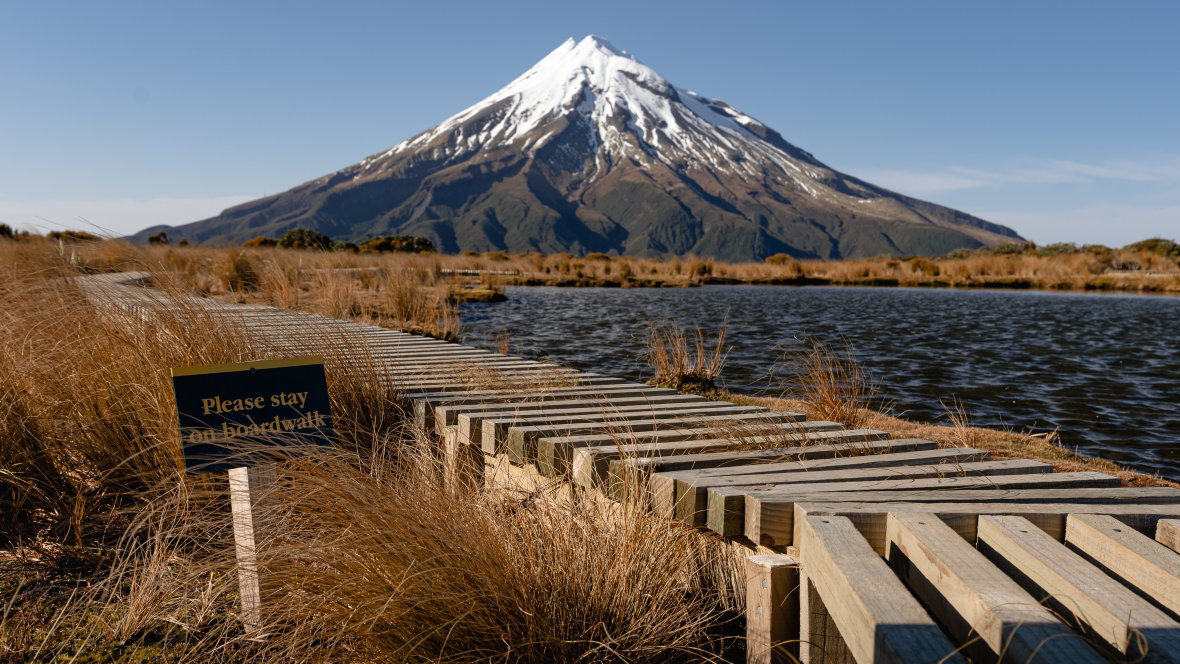
Many visitors come for the magical Kamahi Loop Track through the goblin forest, where gnarled trunks and trailing moss create a fairytale tunnel of green. Others head straight to Dawson Falls, an elegant 18 metre curtain of water that pours into a forested amphitheatre, or to Wilkies Pools where a stream has carved smooth volcanic rock into a chain of natural basins. For hikers, the track network is the big draw. You can take a 15-minute stroll, spend a few hours exploring a waterfall and forest loop, or commit to the celebrated Pouākai Circuit, a 2-3 day tramp that swings past the Ahukawakawa wetlands and the Pouākai Range. The Pouākai Tarn is one of New Zealand’s most photographed spots, offering a still-water mirror of the mountain that is pure magic at dawn or on calm evenings.
On fine summer days, experienced and well-prepared climbers set their sights on the summit route for a challenging, rewarding ascent. Te Papa-Kura-o-Taranaki is also an easy place to enjoy on a road trip. Access roads reach high into the park; there are multiple trailheads for short walks, and coastal views spill out to the Tasman Sea on clear days. It is the kind of destination where you can park up your Britz campervan, wander into the forest for an hour, then return to your rolling base for coffee with a mountain backdrop.
How long should I spend at Te Papa-Kura-o-Taranaki
If you are passing through, a half day is enough to see a signature slice of the park. Pair the goblin forest with a quick stop at Dawson Falls or Wilkies Pools, and you will get the rainforest, waterfalls and volcanic rock that define the area.
With a full day, add a longer viewpoint walk on the northern or eastern side to catch big vistas of Taranaki Maunga and the coast. 2-3 days lets you settle into the rhythm of the mountain. That window is ideal if you want the flexibility to tackle the Pouākai Circuit, wait for a weather window for a summit attempt in summer, or sample a mix of short walks around Dawson Falls and Stratford Plateau. The extra day also builds in a buffer for changeable conditions, which is a smart way to plan in an alpine environment.
How to get to Te Papa-Kura-o-Taranaki
Te Papa-Kura-o-Taranaki sits on the west coast of the North Island, roughly midway between Auckland and Wellington. Many travellers approach via State Highway 3, using New Plymouth, Inglewood or Stratford as supply and fuel bases.
From New Plymouth, the North Egmont road end is about 30-40 minutes. From Whanganui, it is around 1 hour and 45 minutes to nearby towns, and closer to 2 hours to some park road ends. From Auckland, allow about 5 hours, and from Wellington, around 4-5 hours depending on traffic and stops. Reaching park road ends can add 30-40 minutes to town-to-town estimates.
There are three primary access roads into the park. Egmont Road climbs to the North Egmont area and the main visitor centre. Manaia Road serves the Dawson Falls side on the south. Pembroke Road leads to the Stratford Plateau on the east. Each offers a different set of tracks, lookouts and picnic areas. Roads are sealed for much of the way but narrow and winding near the top. Drive with care, give way on tight corners, and check for any seasonal closures or weather advisories before heading up. For campervan travellers, it pays to top up fuel, water and supplies in New Plymouth or Stratford before you head to a trailhead. Mobile coverage varies around the mountain, particularly at higher elevations and in forested valleys.
Best time to visit Te Papa-Kura-o-Taranaki
Summer from December to March is generally the most settled time for hiking, with long daylight hours, milder temperatures on the lower slopes and a better chance of suitable summit weather. Conditions still change quickly on the mountain, so plan with care. This is also the best window for that classic reflection at Pouākai Tarn on calm mornings or evenings. Tracks are popular, so start early for quieter experiences.
Autumn brings cooler air, fewer people and often very clear days that sharpen the views from the ridgelines.
Spring is a transition period with lingering snow on the upper mountain, fresh growth in the forest and rapidly changing weather.
Winter transforms the summit area into an alpine environment, with snow and ice common at altitude. A small club ski area operates on the mountain in season, and higher tracks demand technical skills and gear. Across all seasons, aim for flexibility. Build an extra day into your plan if you are set on a particular hike that needs a good weather window.
Weather in Te Papa-Kura-o-Taranaki
The mountain creates its own weather. Conditions can swing from sunshine to cloud, rain and strong wind in a short span, particularly higher up. The lower slopes around the forest tend to be mild, while the summit can be cold even in summer. Coastal Taranaki towns often see summer highs in the low 20s Celsius and cool winter nights, but expect colder temperatures, wind chill and potential snowfall as you climb. Pack layers year-round. A breathable rain jacket, warm mid-layer, hat and gloves belong in your daypack, even for short walks. Good footwear is essential, as volcanic ash, scoria and wet roots can be slippery. Check the forecast specific to the mountain, not just the coast, on the morning of your hike.
Tickets and entry fees at Te Papa-Kura-o-Taranaki
There is no fee to enter Te Papa-Kura-o-Taranaki or to enjoy its day walks. Hut and campsite bookings on multi-day tramps like the Pouākai Circuit incur charges, and some managed services or concessions may have separate fees. If you are planning to stay in a hut, book early in peak season. Car parks at road ends are free but can fill quickly at popular times.
Best things to do at Te Papa-Kura-o-Taranaki
-
Walk the goblin forest. The Kamahi Loop Track is a short, gentle wander that introduces you to the park’s signature mossy trees and soft green light. It is a great leg-stretcher after a drive and a fantastic spot for photos. If you want a bit more time in the forest without a big climb, link nearby tracks on the North Egmont side.
-
Visit Dawson Falls and Wilkies Pools. These two south-side highlights sit close together and can be combined for a relaxed half day. Dawson Falls rewards with classic waterfall views framed by forest fernery. Wilkies Pools are a series of water-sculpted rock basins that look like they were designed for summer paddling. Take care on wet rocks and keep a respectful distance from fast-flowing water after rain.
-
Hike the Pouākai Circuit. Over 2-3 days, you will circle through lush forest, traverse the unique Ahukawakawa Swamp between the ranges and climb to panoramic viewpoints on the Pouākai Range. Many walkers plan their timing to visit the Pouākai Tarn in calm conditions for that mirror-like mountain reflection.
-
Summit Taranaki Maunga. In fine summer weather, fit and experienced hikers tackle the steep summit route for a full day on the mountain. It is a serious outing with long, relentless scree sections and significant elevation gain. Start early, go only in settled conditions, and be prepared to turn back if the weather or visibility deteriorates. Outside the warmer months, snow and ice make the route an alpine climb that requires technical equipment and knowledge.
-
Seek out viewpoints. On the eastern side, the Stratford Plateau offers big sky views that sweep to the sea. On the coast, the Cape Egmont lighthouse area is a favourite for photographing the mountain rising above farmland and surf, especially at sunrise and sunset.
Best place to park your campervan at Te Papa-Kura-o-Taranaki
- Mangaoraka Carpark, North Egmont: A designated self-contained area near the Egmont Road approach that operates seasonally. Handy for quick access to the goblin forest and North Egmont tracks.
-
Stratford Plateau carparks, East Egmont: Self-contained overnight options close to trailheads and broad viewpoints. A great sunrise base with the mountain on your doorstep.
-
Dawson Falls carpark, south side: Self-contained overnight parking near the falls and Wilkies Pools tracks. Expect early walkers and waterfall-chasers in the morning.
-
Egmont Eco Leisure Park, New Plymouth: A holiday park with grassy camping sites, a shared kitchen, showers and lawns shaded by mature trees. A comfortable base within easy driving of multiple road ends.
-
North Egmont Retreat, Egmont Village: A convenient option on Egmont Road with powered sites and cabins a short drive from the park entrance. Useful if you want facilities and a quick start the next morning.
If you need dump stations or extra power, plan a night at a holiday park before or after your time at the road ends. New Plymouth and Stratford both offer supermarkets, fuel, laundries and supplies for restocking your Britz before the next leg of your journey. Travelling by camper makes exploring Taranaki easy and flexible. Pull into a trailhead for a morning walk, return to your rolling kitchen for lunch with a view, then shift to a different side of the mountain for a sunset stop. With a campervan, you get the freedom to follow the weather and your curiosity without repacking between every outing.
FAQs and quick answers
-
Where is Te Papakura o Taranaki?
On the western North Island, wrapping Taranaki Maunga above New Plymouth/Stratford with access roads at Egmont Road, Manaia Road and Pembroke Road. -
Is the Pouākai Crossing a day walk? How long is it?
Yes. It’s a full day alpine/tramping route traversing cliffs, wetlands and ridges on the Pouākai Range; allow 8+ hours for fit, prepared walkers. -
How far is it to Pouākai Tarns?
From Mangorei Road, it’s 5 km one way on boardwalk/steps to the tarns and nearby hut; allow 2–3 hours up depending on conditions. -
What’s the Wilkies Pools Loop like?
A 1.9 km easy–intermediate loop through mossy forest to a series of lava-sculpted pools; allow around 1 hr 20 min. Great for families in fine weather. -
Can I freedom camp at North Egmont?
Freedom camping is prohibited at the North Taranaki Visitor Centre car park. Overnighting is permitted at Stratford Plateau and Mangorei Road car parks (for self-contained campervans).
Road trips that pass through
14 Day North Island Itinerary: Auckland Round Trip via Wellington for the Faultline Ultra Marathon
North Island Bucket List Road Trip: Cape Egmont Half Marathon Campervan Adventure
Ultimate Lord of the Rings road trip itinerary - North Island
Best hikes on the North Island
The Ultimate Rugby Fan's Auckland to Palmerston North Road Trip