.jpg)



Join thousands of fellow campervan travellers
Sign up for our Britz newsletter to receive inspirational travel content and awesome deals, and we'll send you a copy of our Ultimate RV guide!
Thanks
Please confirm subscription in your email.
kunanyi / Mount Wellington
Just minutes from Hobart, the road climbs through eucalypt forest and subalpine scrub to the summit of kunanyi / Mount Wellington, where sweeping views take in the River Derwent, the city’s neat waterfront, and on clear days the profiles of Bruny Island and Storm Bay. Step out onto the viewing platforms for a first taste of Tasmania’s vastness, or follow a short track to feel the wind and listen for currawongs calling across the rocks.
If time allows, lace up for a section of the Organ Pipes Track or an easy stroll around the summit’s alpine landscape. The mountain is a perfect first stop to reset your pace to island time before rolling on toward the coast.
Tasman Peninsula: cliffs, capes and sea stacks
Driving south-east toward Port Arthur, the road narrows to the Tasman Peninsula where dolerite cliffs rise sheer from the sea. Park up and take the trail to Cape Raoul for a day hike with cliff-edge views and thundering surf below, or join a coastal cruise for close-up encounters with soaring columns, blowholes, and seabird rookeries. Remote beaches curve beneath the headlands and the light shifts constantly across the water. Keep an eye out for dolphins arcing through swells and fur seals basking on ledges as you circle back to your van for a golden-hour picnic.
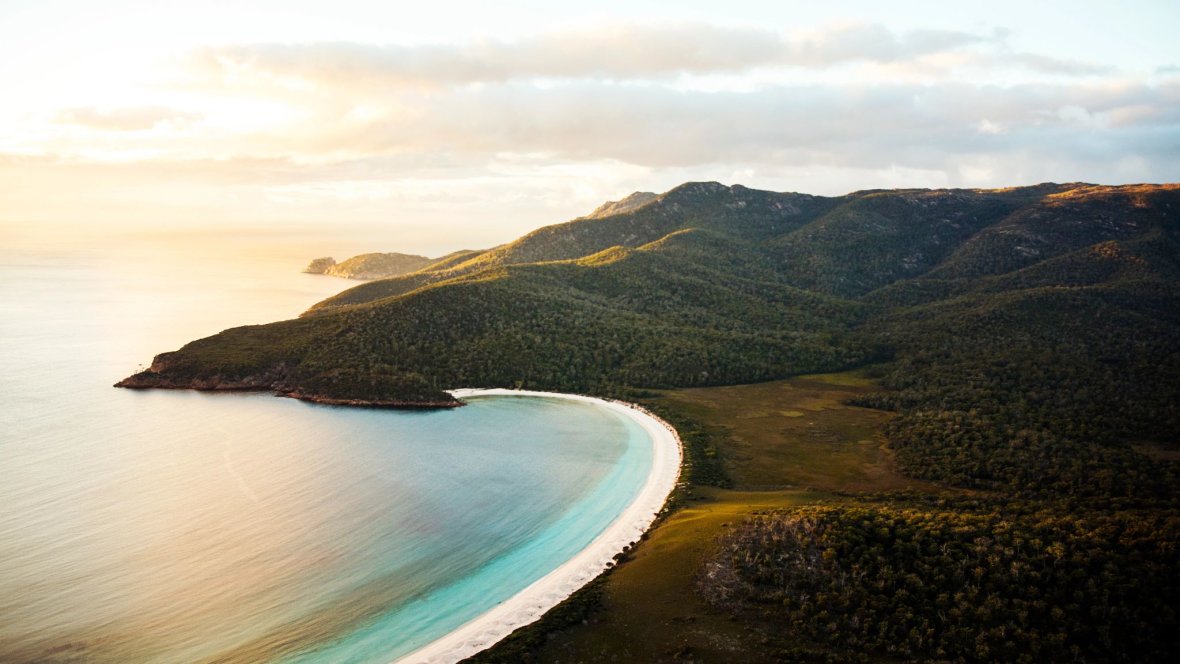
Freycinet National Park: Wineglass Bay and the Hazards
On the Freycinet Peninsula, rose-pink granite peaks rise behind turquoise bays. The walk to Wineglass Bay Lookout is short yet invigorating, and the reward is a perfect curve of white sand set against deep-blue water. Take the longer route down to the beach if you have time, then return via the saddle for different perspectives of the Hazards.
Between hikes, visit sheltered coves like Honeymoon Bay and Sleepy Bay for swims and snorkels on calm days. Wallabies often graze near the carparks at dusk, and the dark skies here make for excellent stargazing when conditions are clear.
Larapuna / Bay of Fires
The east coast opens into Larapuna / Bay of Fires, where white sand runs for kilometres and orange lichen paints the granite boulders vivid against crystalline water. Park near Binalong Bay or make your way to Cosy Corner, then wander barefoot along the tide line, pausing to watch oystercatchers and terns comb the shore. On a calm morning, slip into the water for a quick snorkel or paddle a sheltered inlet. Choose protected coves and be mindful of rips and changing conditions. Sunset turns the lichen even brighter and mornings are often glassy, perfect for that first cup of coffee by the beach.
Narawntapu National Park and Greens Beach
North of Launceston, Narawntapu is often called the Serengeti of Tasmania for its wildlife-filled grasslands. As evening falls around Springlawn, you can watch Bennett’s wallabies, pademelons, and sometimes forester kangaroos emerge to graze. By day, long, quiet beaches invite unhurried walks and birdwatching along tidal flats. Base yourself near Greens Beach at the mouth of the Tamar River for easy access to coastal tracks and peaceful bays. If you are lucky, you might spot an echidna snuffling along the track or a platypus in a still creek at dawn.
Liffey Falls and the Great Western Tiers
Turn inland to the Great Western Tiers for a cool change beneath a rainforest canopy. The trail to Liffey Falls passes towering myrtles, moss-draped logs, and groves of tree ferns before arriving at the tiered cascade. The river ribbons over ancient rock shelves into clear pools that gurgle and gleam in dappled light. This is a gentle, restorative stop for most visitors via the upper car park track, with picnic areas and short detours to viewpoints. Access and road conditions can change seasonally, so check current information before you go.
Cradle Mountain and the Dove Lake Circuit
Cradle Mountain’s jagged profile and the dark mirror of Dove Lake form one of Australia’s most iconic alpine scenes. The 6 kilometre circuit around the lake is a must, winding past button grass moorland, beaches of quartzite pebbles, and pockets of old-growth rainforest with pencil pines and beech. In still weather, the mountain often reflects in the lake, and even on moody days the setting is richly atmospheric. Arrive early to meet wombats on the move, listen for black cockatoos, and breathe the resin-rich forest air.
Lake St Clair: highland calm and big-sky nights
At the southern end of the same national park, Lake St Clair is Australia’s deepest freshwater lake. The shoreline offers a web of short and half-day walks through forests of eucalypt and leatherwood, with clearings that open to wide views across the water. The Shadow Lake Circuit is a standout for those with a few hours to spare. Come dusk, the high country becomes a stage for star-filled skies. With the van tucked among trees near the lake, you can step outside to a hush broken only by the call of a boobook owl or the ripple of a nocturnal platypus.
Franklin-Gordon Wild Rivers and Nelson Falls
Western Tasmania is a tapestry of tannin-dark rivers, huon pine forests, and moorland plains. From Strahan, a Gordon River cruise glides through mirror-like reaches where rainforest leans over the water and birds skitter along the surface. On the Lyell Highway, stretch your legs on the short boardwalk to Nelson Falls, where a broad curtain of water splits into veils over mossy steps. Across this corridor between river and road, lookouts, picnic nooks, and photo stops invite regular pauses as you drive.
Mount Field National Park: waterfalls and alpine tarns
Closer to Hobart, Mount Field condenses Tasmania’s variety into a single park. Start with the easy circuit to Russell Falls and Horseshoe Falls, passing ferns the size of umbrellas and towering swamp gums. The Tall Trees Walk showcases some of the tallest flowering plants on Earth, their trunks rising straight into the canopy. Drive higher to Lake Dobson for a different world of alpine moorland, cushion plants, and icy-clear tarns. Even a short amble here carries the scent of tea tree and the sound of wind folding over the plateau.
Trowutta Arch, north-west rainforest
The north-west’s cool forests are full of geological surprises. A brief, gentle walk leads to Trowutta Arch, a natural stone arch formed by ancient sinkholes. Ferns fringe a deep green pool beneath the arch, and shafts of sunlight spotlight the scene through the trees. It is a stop that rewards patience and a slow wander with your camera at the ready.
Corinna and takayna / Tarkine
Deep in the north-west, the tiny settlement of Corinna sits where rainforest meets the Pieman River. Hire a kayak or join a small boat to glide past hanging gardens of moss and the twisted forms of huon pine, or follow a trail to Lover’s Falls for a quiet slice of riverbank wilderness. Use Corinna as a gateway to Takayna, also known as the Tarkine, a vast sweep of temperate rainforest, buttongrass plains, and wild coast. The driving loops and short walks reveal ancient sinkholes, sweeping lookouts, and beaches where the Roaring Forties roll ashore. It is remote and restorative, a chance to feel the scale of Tasmania’s wild heart.
How to stitch it together
There is no single right way to drive Tasmania, though a clockwise loop connects these highlights with minimal backtracking. Start with city provisions, then aim for two or three nature stops per region where distances and conditions allow, so most days include one signature walk and a swim or scenic pause. Many national parks have carparks and day-use areas that put trailheads and picnic spots right beside your van. Some places use shuttle systems or have vehicle restrictions, such as at Cradle Mountain, so check access details and road conditions in advance.
Timing helps. Early mornings are best for wildlife and calm views. Afternoon sea breezes can pick up on the coast, so choose sheltered beaches or swim earlier in the day. Evenings can deliver clear southern skies for stargazing when weather and conditions align. With ancient forests, cliff-lined peninsulas, and mountain lakes strung like beads along every highway, Tasmania rewards those who keep the itinerary simple and the windows down. Pick a handful of these stops, plan for extra time at the ones that move you, and let the island’s wild places set the rhythm of your road trip.
FAQs and quick answers
-
What is the best road trip in Tasmania?
There is no single official best road trip, but a clockwise lap of Tasmania is one of the strongest options for first-timers because it links Hobart, the Tasman Peninsula, Freycinet, the Bay of Fires, Cradle Mountain and the west coast with minimal backtracking. -
How many days are needed for a Tasmania road trip?
About 10 to 14 days is a good amount of time for a satisfying Tasmania road trip if you want to see several regions without rushing. Discover Tasmania’s featured island loop is 14 days, which is a strong guide for a fuller first visit. -
What should you not miss in Tasmania?
For many first-timers, the standout nature-and-history mix includes Cradle Mountain, Freycinet and Wineglass Bay, the Tasman Peninsula, Bay of Fires, and Port Arthur. -
Where to go in Tasmania for first-timers?
A great first trip usually includes Hobart, kunanyi / Mount Wellington, the Tasman Peninsula, Freycinet, Bay of Fires, Cradle Mountain and part of the west coast. That combination gives you a strong mix of scenery, wildlife, coast and classic Tasmania stops. -
What is the best month to go to Tasmania?
There is no single best month for everyone. Any time is a great time to visit, but for warm-weather road trips, December to February is the classic choice, while March and April are excellent for cooler days and autumn colour.
Ready to road trip Tasmania’s wild side?
From Hobart’s mountain backdrop and the sea cliffs of the Tasman Peninsula to Wineglass Bay, Cradle Mountain and the western rainforests, Tasmania is packed with nature stops that are ideal for a campervan holiday. The beauty of travelling by campervan is that you can move at your own pace, keep the itinerary simple, and spend longer in the places that feel worth it.
Hire a Britz camper and plan a Tasmania road trip built around beaches, forests, mountains and wild coastal detours with plenty of room to stop whenever the view tells you to.