.jpg)



Join thousands of fellow campervan travellers
Sign up for our Britz newsletter to receive inspirational travel content and awesome deals, and we'll send you a copy of our Ultimate RV guide!
Thanks
Please confirm subscription in your email.
Why do people go to Karlu Karlu / Devils Marbles?
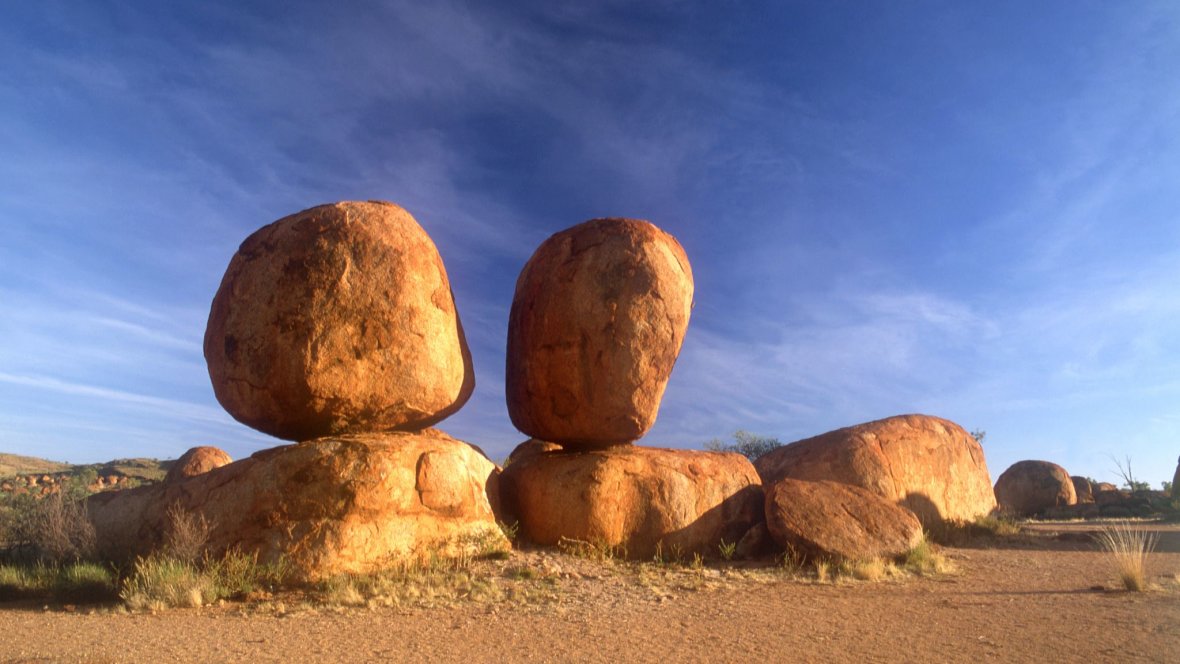
People come to Karlu Karlu for that “how is this real?” moment, when you see the enormous, rounded boulders scattered across the desert like a giant’s game of marbles. The shapes are astonishing, from perfectly balanced spheres to cracked domes split clean in two. In the low light of morning and evening, the rocks turn deep red and cast long shadows that can look cinematic.
It is one of the Northern Territory’s most recognisable landscapes, yet it is small enough to explore on foot without needing a big day on the trail. Equally compelling is the cultural significance. Karlu Karlu means round boulders, and the site is sacred to Traditional Owners. Visitors are asked not to climb the rocks out of respect for cultural values. Surfaces can also be uneven and slippery in places.
Interpretive signs share stories and geology in pockets among the formations. The combination of scenery, walks, wildlife sightings, and a sense of place makes this a must-see stop on an outback itinerary.
How long should I spend at Karlu Karlu / Devils Marbles?
A quick stop of 45-90 minutes suits many travellers. That gives time to park near the main boulder field, wander one of the short self-guided loops, read a few signs, and capture photos as the light shifts.
If you can, plan your day so you are here for either sunrise or sunset. The colour change is dramatic, and the temperature is kinder. With children or older travellers, allowing a little longer keeps the pace relaxed and lets everyone enjoy the setting. To truly appreciate the reserve, consider an overnight stay.
Camping beside the Marbles means you can watch the sunset glow fade, stargaze in clear desert air, then wake for a sunrise walk when the rocks feel most alive. Many road trippers treat this as a one-night pause between Alice Springs and Tennant Creek, which breaks the drive and builds a memorable highlight into the journey.
How to get to Karlu Karlu / Devils Marbles
Karlu Karlu sits directly beside the Stuart Highway in the Barkly region. It is about 96 kilometres south of Tennant Creek, roughly 1 hour by road, and about 393 kilometres north of Alice Springs, around 4.5 hours in a campervan. The turnoff is clearly signed, and the access roads within the reserve are suitable for two-wheel drive vehicles. You can see the boulders from the highway, yet the short drive inside quickly delivers a sense of calm away from the traffic of the long haul route.
Services are limited in this stretch of outback highway, so plan fuel and water with care. Wauchope, about 9 kilometres south, has the Devils Marbles Hotel for fuel and basic supplies, while Tennant Creek offers full services, supermarkets, mechanics, and medical care. If you are driving from Darwin or Katherine, the reserve makes a natural pause on the journey south. From Adelaide or Coober Pedy, it becomes a dramatic highlight as you continue north through the Territory. Always check road conditions and avoid driving at dusk when wildlife is most active there on the highway.
Best time to visit Karlu Karlu / Devils Marbles
The reserve is open year-round, with the most comfortable conditions typically from April to September when days are mild and nights can be crisp. In this season, walking is pleasant at any time, and the light is often crystal clear for photography.
Spring and late autumn also work well. Summer can be extremely hot, with daytime temperatures often climbing well into the high thirties and sometimes above forty. If visiting between October and March, plan early mornings and late afternoons, seek shade at midday, and keep your water supply topped up.
Whenever you come, try to be on site for at least one golden hour. Sunrise washes the boulders with soft pastels and bird song. Sunset brings that famed deep red glow and long shadows. If clouds arrive, do not worry, as broken light often adds drama to your photos.
Weather in Karlu Karlu / Devils Marbles
Karlu Karlu sits in a semi-arid climate that is typically dry and sunny. Summer highs from December to February often push into the high thirties and can exceed forty, with warm nights that offer little relief.
Winter days often sit in the mid-20s Celsius, and nights can be chilly, so a warm layer helps around camp. Rain is generally infrequent, though summer and the build-up to the wet season can bring short lived storms with lightning. No matter the month, bring a wide-brimmed hat, sunscreen, and plenty of drinking water and snacks,too.
Things to do and unmissable sights at Karlu Karlu / Devils Marbles
-
Take your time to walk among the Marbles on the easy self-guided tracks that weave between boulders. A short loop near the main car park takes about 15 minutes, with signs that explain how the granite formed and why the boulders are so perfectly rounded.
-
Look for dramatic balancing rocks and the famous split boulders that reveal a fresher, darker interior against a paler weathered rind.
-
Pause to watch tiny black-headed goannas warming themselves in crevices. Listen for zebra finches and painted finches, and look up for the mud nests of fairy martins under overhangs.
-
Photography is front and centre here, so keep your camera or phone handy. The rocks change tone minute by minute as the sun rises or sinks, and even shadows on sand make beautiful compositions.
-
Please do not climb the boulders. The site is sacred to Traditional Owners. Instead, step back to frame the scale of these ancient forms, or include your campervan in a wide shot to tell the road trip story.
-
After dark, switch to stargazing, as the desert sky often sparkles with bright constellations. Free Wi Fi lets you check sunset times too.
Entry fees and permits for Karlu Karlu / Devils Marbles
Most visitors need an NT Parks Pass to enter Karlu Karlu. A one-day adult pass is usually $10, with child and family options available, and Northern Territory residents are exempt with proof of residency. Buy your pass online before you arrive. Keeping a copy handy on your phone is useful.
If you plan to camp, there is a small additional campground fee per night that must also be booked and paid online in advance. Prices change from time to time, so confirm current details when planning your itinerary. You may need to display it when asked by rangers.
Best place to park your campervan at Karlu Karlu / Devils Marbles
For day visits, follow the signs to the main car parks beside the boulder fields. There is a large sealed car park suitable for campervans, with space to turn. Park on formed surfaces only and avoid soft shoulders near the rocks.
If you are staying the night, the reserve’s bush campground is your best bet. Sites are unpowered and within walking distance of the formations, making it easy to catch sunset lookouts. Facilities are basic pit toilets, picnic tables, and fire pits when conditions allow. There is no tap water or electricity on site. You will have to book and pay for a campsite online before you arrive, as there is no on-site payment. In busy periods, book early and arrive by late afternoon to settle in before dark.
Bring all the water you need for drinking and dishes, and plan to take your rubbish with you. Generators are not permitted. Please keep noise low after dark to preserve the atmosphere. If you prefer full-service facilities, several caravan parks operate in Tennant Creek, about an hour to the north. The Devils Marbles Hotel in Wauchope, 9 kilometres south, is handy for fuel and basics before you settle in at camp for the night.
Safety tips and things to watch for at Karlu Karlu / Devils Marbles
This landscape invites exploration, but conditions can be harsh.
-
In hot months, start early, rest in shade through the middle of the day, and carry more water than you think you will need.
-
Wear sturdy shoes, as the ground is uneven and sandy, and keep to formed tracks where possible.
-
Do not climb the boulders. The site is sacred, and climbing increases the risk of falls on smooth rock.
-
Give wildlife space, including goannas and snakes, and never leave food out.
-
Drones and generators are not allowed.
-
When driving, be cautious of road trains on the Stuart Highway and use headlights at dawn and dusk for visibility.
-
Carry a torch for night walks and watch for loose stones and edges.
Karlu Karlu is the kind of place that turns a good road trip into a great one. It is easy to reach, unforgettable in the light of dusk and dawn, and welcoming to campervans that value simple, starry nights. Plan smart for heat and respect the cultural wishes not to climb these sacred boulders. Book your Britz campervan, point it down the Stuart Highway, and make this icon part of your story.
FAQs and quick answers
-
What is special about Devils Marbles?
It’s a concentrated field of enormous, rounded granite boulders (many balanced or split) that glow dramatically at sunrise and sunset, with short walks that make it easy to explore. -
Can you climb Devils Marbles?
Visitors are asked not to climb the boulders out of respect for the site and its cultural significance (and because the surfaces can be risky). -
Where is Karlu Karlu located?
In the Northern Territory, just off the Stuart Highway, about 100 km south of Tennant Creek. -
What do the rocks at Karlu Karlu look like?
Think giant, rounded granite “marbles”: smooth domes, stacked/balancing boulders, and rocks split cleanly in half - scattered across red sand like a natural sculpture park.
Road trips that pass through