.jpg)



Join thousands of fellow campervan travellers
Sign up for our Britz newsletter to receive inspirational travel content and awesome deals, and we'll send you a copy of our Ultimate RV guide!
Thanks
Please confirm subscription in your email.
Quick rules for Britz Outback 4WD trips
Before we dive into the details, keep these key rules in mind for Britz 4WD hires:
- Fresh water crossings must be no deeper than 30 cm or below the height of the driveline (around halfway up the tyre), whichever is lower.
- No saltwater drives are permitted at any time.
- Sand driving is only allowed on approved inland and Outback tracks. Beach driving is not permitted in your 4WD hire.
- All Britz 4WDs are automatic. The branch teams will show you how to use the low range and the transmission for different conditions.
- Do not attempt complex vehicle recoveries yourself. If you are stuck or unsure, call the 24/7 Britz helpline – the number is on your vehicle key tag.
- Always follow the advice we provide you with for 4WD hires, local road closures, fire bans and any track restrictions.
The rest of this guide walks you through how to apply these rules on real Outback tracks so you can enjoy the adventure and stay safe.
Build a safe Outback plan before you go
Remote driving starts at home, before you even pick up your Britz 4WD.
Map out your route, make a note of fuel stops and water points, and keep your daily distances realistic. A single storm can close a road, so check official road conditions and weather before you leave, and again each morning of your trip.
Leave a simple trip plan with a trusted contact that includes:
- Your planned route
- Overnight stops
- Check-in times
If your plans change, let them know. Travelling with another vehicle is ideal, but even an informal convoy adds a good safety margin.
Because coverage is patchy, don’t rely on mobiles alone.
- Use UHF for road trains and local traffic (Channel 40 on highways, others as signed).
- Hire a satellite phone from the Britz branch if you’re planning heading into more remote areas.
Fuel and water planning is straightforward but important:
- Fill when you can and aim to top up by the time your tank is half empty.
- Budget 4–10 litres of water per person per day and carry a multi-day reserve.
- Pack a bit of extra non-perishable food and make sure key info like your navigation is available offline.
Get to know your Britz 4WD
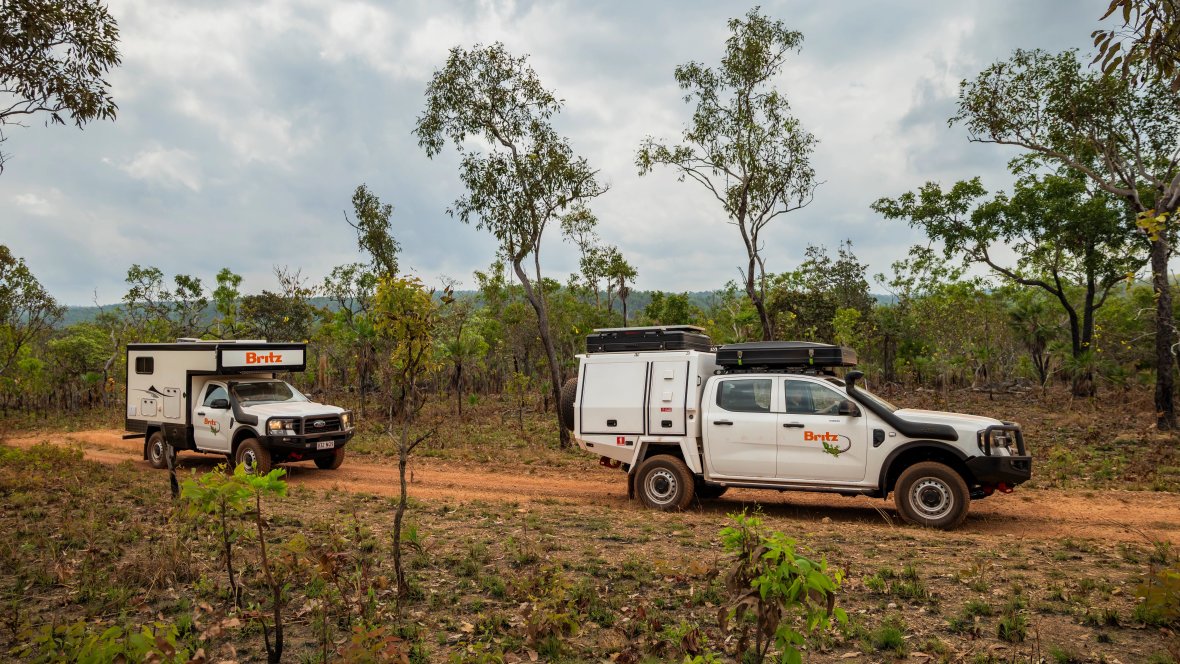
When you pick up your Britz 4WD, you don’t need to worry about servicing or mechanical checks – the branch team has already taken care of that. What is worth spending time on is getting to know how your vehicle works before you hit the dirt.
At handover, the team will walk you through things like:
- How to switch between high and low range
- How the automatic gearbox behaves on hills, rough tracks and sand
- Any gear that’s included with your hire (compressor, tyre gauge, shovel, traction boards)
- Key safety and usage rules for your route
This is the time to ask questions. If there’s anything you’re unsure about – a warning light, a button on the dash, how to engage low range – ask the team to show you. It’s much easier to learn in the depot than on a remote track. Make sure you print out a copy of the special advice for your hire, just in case you’re unsure of anything.
One important thing to remember: don’t modify the vehicle. That means no extra accessories (like snorkels or suspension lifts) and no attaching heavy recovery gear to the vehicle’s recovery points - those are there for qualified recovery operators and emergency services only.
If a warning light comes on, the vehicle suddenly feels different, or you’re just not sure something is right, pull over somewhere safe and call the 24/7 Britz helpline. They’re there to help you decide what to do next.
Tyre pressures that work in the Outback
Tyres are your most effective suspension on dirt. Adjusting pressures for the terrain can make your ride more comfortable, give you better control and reduce stress on the vehicle.
As a general guide, many 4WDs work well with cold pressures in the mid-20s psi on typical dirt roads, with slightly higher pressures at the rear when you’re carrying more weight. Use the advice from your Britz branch and the vehicle information as your starting point.
Many Britz 4WDs include a compressor and pressure gauge so you can air down and reinflate. When you lower pressures:
- Reduce your speed
- Avoid sharp steering inputs
- Check tyre and shock absorber temperatures at rest stops
If the tyres are getting very hot, your pressures may be too low for your current speed and conditions.
On soft sand and dunes, dropping pressures further lets the tyre footprint lengthen and float rather than dig in. Many drivers work in the mid to high teens psi in softer sand, adjusting as needed to keep smooth momentum without wheelspin. Always reinflate before returning to sealed roads – low pressures at highway speeds can damage tyres. If you’re unsure what pressures to run, stop in a safe place and call the Britz helpline rather than guessing.
Mastering corrugated dirt roads
Corrugations are the classic Outback “washboard” surface. They’re tiring to drive on, but good technique makes a big difference.
- Engage 4WD high range to help stabilise the vehicle (follow the instructions from your handover).
- Air down to suitable dirt-road pressures so the tyres can absorb some of the chatter.
- Find a steady speed that smooths the ride without compromising control. If the vehicle feels light or skittish, slow down.
Avoid heavy braking and sudden steering while you’re on corrugations, especially mid-corner. Stay out of the dust plume of vehicles ahead so you can see and so your engine air intake breathes cleaner air.
Stop periodically to check for anything that looks loose or out of place. If you notice a change in how the vehicle feels or a warning light appears, call the Britz helpline before continuing. For more technique tips, see our guide to know how to drive a 4WD.
Reading and crossing water safely

Creeks and floodways change with the seasons. Never assume yesterday’s crossing is the same today. In your Britz 4WD, there are clear limits you must remember to follow:
- Fresh water crossings must not be deeper than 30 cm or roughly halfway up the tyre, whichever is lower.
- The vehicle must never come into contact with salt water. Any salt water damage is at your expense.
If a crossing looks within those limits and is open, take your time. If it’s safe to do so, walk it first to check the depth, the strength of the current, how firm the base is and where you’ll enter and exit. If depth or flow is uncertain, turn back or choose another route. When in doubt, don’t cross.
In a Britz 4WD, select low range where appropriate and use a mode that gives steady pace. Enter slowly, build a gentle bow wave and hold a steady pace. Avoid stopping or spinning the wheels mid-stream. At this point it's good to avoid changing gear if possible, as this can let water into the clutch plates and increase slip.
Once you’re clear, gently apply the brakes to dry them. If conditions change after rain, wait for levels to drop or seek local advice rather than pushing through. Don’t try to rig recovery straps or winches in or near water. If you become stuck or unsure, move to higher ground if needed and call the Britz helpline. For a detailed breakdown, follow our tips to crossing water in a 4WD.
Sand, dunes and bulldust
Sand driving can be one of the highlights of an Outback trip when you get the technique right. In a Britz 4WD, sand driving is only permitted on approved inland and Outback sand tracks that are open to 4WDs. Beach driving is not permitted at any time.
On sand, go slow and use low range where it’s appropriate. Make sure to keep your momentum smooth and steady, not fast. Approach dune faces straight on, ease off slightly as you near the crest, then drive gently over once you can see the descent. If your hire includes a sand flag, use it on popular routes so other drivers can see you coming.
If you become bogged, resist the urge to spin the wheels. Instead:
- Drop pressures a little further, within safe limits
- Clear sand from in front of the tyres with a shovel
- Use any supplied traction boards to create a gentle ramp, if it’s safe to do so
If you can’t get moving, stay with the vehicle and call the Britz helpline rather than improvising with non-rated gear.
Bulldust may look like harmless powder but can hide deep holes and ruts. Treat grey-brown talc-like patches with respect:
- Slow right down
- Maintain gentle, steady momentum through the patch
- Avoid stopping in the deepest sections
If a hole looks too deep or badly cut up, stop short and choose another line or a different route.
Remote driving smarts that save trips

A few simple habits go a long way towards keeping your trip on track.
Wildlife and livestock are most active at dawn and dusk. Aim to be off the road at these times where you can, and avoid last-second swerves. Controlled braking in a straight line is usually safer than a sudden swerve on gravel.
On single-lane bitumen and narrow gravel roads:
- Slow early for oncoming road trains
- Move well left and be prepared to stop
- Use UHF to coordinate if needed
- Wait for dust to clear before speeding up again
Fatigue builds quickly in the heat and vibration of Outback driving. Rotate drivers, take regular short breaks and drink water often. Shade, long sleeves, a hat and sunscreen make hot days, delays and any recovery situations much more manageable.
Choose campsites that are well off the road and on firm ground. Respect station gates and signage, and only use designated fire pits when there are no fire bans in place. Pack out what you pack in. In remote towns, support local businesses, refuel, top up water and ask about track conditions – a quick chat at the bowser can be more useful than any app.
Recovery and emergencies in a Britz 4WD
If something goes wrong, the most important thing is to stay safe and avoid turning a small problem into a big one. Britz 4WDs are fitted with recovery points for use by qualified recovery operators and emergency services. Guests shouldn’t attach winches, snatch straps or other heavy recovery equipment to the vehicle.
If you become stuck:
- Stay calm and keep everyone away from traffic
- Stay with the vehicle unless it’s unsafe (for example, fire or rising water)
- Use your UHF, satellite phone or mobile (if in range) to call for help
Your vehicle key tag includes the number for the 24/7 Britz helpline. Call this line for recovery assistance or advice on what to do next. The team can help coordinate support or advise whether to wait, backtrack or seek local services.
Your vehicle comes with a well-stocked first aid kit. If you can, complete basic first aid training before your trip. On very remote routes, we recommend you carry a personal locator beacon and hire a satellite phone from the branch as an extra safety net.
A simple daily routine out there
A quick daily check-in with your vehicle helps catch small issues before they grow. It only takes a few minutes. Start each morning with a quick walk around. Check tyre pressures and look for nails or cuts, inspect underbody for new leaks, confirm wheel nuts and recovery points are tight and that nothing has shifted in the cabin or canopy.
Throughout the day, feel your shock absorbers and tyres at stops. Excess heat tells you to slow down. If you adjust pressures on hot tyres, do so cautiously and recheck when they have cooled. Each evening, clear grass seeds from radiators, clean air filters if dusty, and log your fuel and water so you know your range for tomorrow.
Respect Country and leave no trace

Many iconic tracks traverse Aboriginal lands, pastoral leases and national parks. It’s a privilege to travel through these places, and a few simple habits help keep them special.
- Obtain permits where required
- Stick to existing tracks and avoid closed roads
- Camp only where it’s permitted and be considerate of other travellers, Traditional Owners and local communities.
- Keep noise down, take all your rubbish with you, and dispose of it thoughtfully and in the correct rubbish bin.
Treat waterholes as precious. Do not swim or wash in drinking sources, and never dump grey water into creeks. These are small habits that safeguard the privilege of exploring the Outback.
These small actions help keep tracks open, protect fragile environments and show respect for Country. With the right tyre pressures, steady hands on the wheel and a plan that respects distance, weather and local rules, the Outback opens itself slowly and generously. Those long red roads aren’t just a way to get somewhere – they’re the adventure itself.
FAQs and quick answers
- How deep can I take my Britz 4WD through water?
We only permit shallow freshwater crossings up to 30 cm or roughly halfway up the tyre, whichever is lower. If you’re unsure, don’t cross – find another route or turn back. - Can I drive my Britz 4WD on the beach?
No. Beach driving is not permitted at any time in Britz 4WD vehicles. Sand driving is limited to the list of approved inland and Outback tracks. - Are Britz 4WDs automatic?
Yes, all Britz 4WDs are automatic. At pick-up, our team will show you how to select low range and use the automatic transmission for steep, rough, or sandy sections. - What should I do if I get bogged or stuck?
Stay calm, stay with the vehicle if it’s safe, and call the 24/7 Britz helpline using the number on your key tag. Don’t attempt complex recoveries with straps, winches, or towballs. - Do I need to service or modify the 4WD before going remote?
No. Your Britz 4WD is serviced and checked by our team before you collect it. Make sure to drive within the conditions of hire, follow local advice, and contact us if something doesn’t feel right.